




Showing 20 search results of 6,246 videos found for
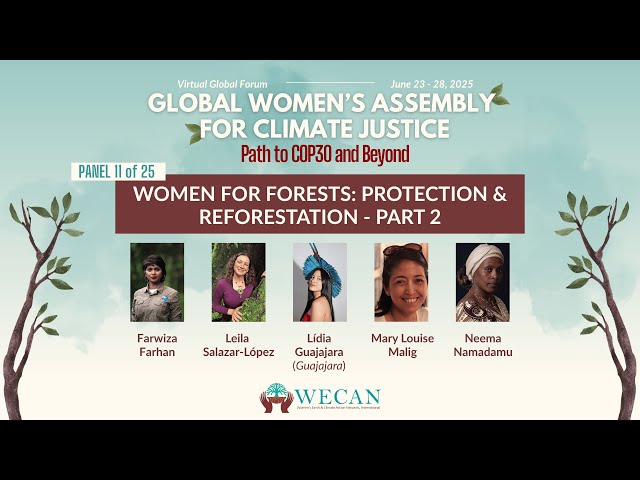
The Women’s Earth and Climate Network (WECAN) hosted the Global Women’s Assembly for Climate Justice: Path to COP30 and Beyond from June 23-28, 2025. This virtual forum united over 125 grassroots and frontline women leaders, advocates, and policymakers from 50 countries. Through 25 panels, participants shared diverse strategies for a healthy and just world.
A significant session, "Women for Forests: Protection & Reforestation: Part 2," took place on June 25. It featured prominent women leaders and experts from various global organizations, discussing critical forest protection and reforestation initiatives. The assembly offered interpretation in English, Spanish, French, and Portuguese.

The Global Women's Assembly for Climate Justice: Path to COP30 and Beyond, hosted by the Women's Earth and Climate Network (WECAN) from June 23-28, 2025, featured the panel "Rematriating the Land: Indigenous Sovereignty and the Land Back Movement" on June 24.
Prominent Indigenous leaders participated, including Bryanna R. Brown, Janene Yazzie, Taily Terena, and Pluma Bárbara Moreno Torres, with moderation by Dr. Lyla June Johnston. These leaders represented diverse nations from Canada, Diné Bikéyah, Brazil, and Puerto Rico.
The assembly convened over 125 grassroots women leaders, advocates, and policymakers from 50 countries. Across 25 panels, participants showcased varied visions and strategies to accelerate a transformative path toward a healthy and just world.

The Global Women’s Assembly for Climate Justice: Path to COP30 and Beyond, hosted virtually by the Women’s Earth and Climate Network (WECAN) from June 23-28, 2025, convened over 125 grassroots and frontline women leaders, global advocates, and policymakers from 50 countries. This forum featured 25 unique panels showcasing diverse visions, projects, and strategies to accelerate a transformative path to a healthy and just world, with interpretation available in English, Spanish, French, and Portuguese.
Among the key sessions was the panel “Healing Justice in the Climate Crisis: Restoring Mind, Body, and Spirit,” held on June 25th. Panelists included Cara Page (Changing Frequencies, Healing Histories Project, Turtle Island/USA), Zainab Salbi (Daughters for Earth, Turtle Island/USA), Dr. Vivian Tatiana Camacho Hinojosa (Ancestral Traditional Medicine, Bolivia), Nina Simons (Bioneers, Turtle Island/USA), and Daiara Tukano (Indigenous activist and artist, Brazil). Resources shared during this panel and across the entire Assembly are available here.

In her 2021 TEDxSeattle talk, K. Killian Noe discusses the power of authentic community, defining it as being deeply known and deeply loved. Her life's work focuses on equipping individuals to emerge from trauma and its symptoms, including homelessness, addiction, and depression.
Killian emphasizes that community provides the tools for healing, teaching us to embrace love instead of fear. She is a cofounder of the Recovery Network, an author, and a mental healthcare advocate.

The Global Women’s Assembly for Climate Justice: Path to COP30 and Beyond, hosted virtually by the Women’s Earth and Climate Network (WECAN) from June 23-28, 2025, convened over 125 grassroots women leaders and advocates from 50 countries. Across 25 panels, including "Oceans, Freshwater, and Climate" on June 27th, participants presented diverse visions and strategies for a healthy, just world. The Assembly offered interpretation in English, Spanish, French, and Portuguese.
Resources from the "Oceans, Freshwater, and Climate" panel and the entire Assembly are available here. Learn more about the Assembly here.

The Global Women’s Assembly for Climate Justice: Path to COP30 and Beyond, hosted by the Women’s Earth and Climate Network (WECAN) from June 23-28, 2025, featured a panel titled “Implementing the Escazu Agreement: Protecting Women Land Defenders and the Defense of Nature in Latin America & the Caribbean.” This session, held on June 27th, included distinguished panelists such as Patricia Madrigal Cordero, Ruth Spencer, Fany Kuiru Castro, and Patricia Gualinga.
The virtual Assembly brought together over 125 grassroots women leaders, advocates, and policymakers from 50 countries. Across 25 panels, participants shared diverse strategies for a healthy and just world, with interpretation in English, Spanish, French, and Portuguese.
Resources from the panel and Assembly are available here. Learn more about the Assembly here.

The panel "Indigenous Women From Brazil on the Path to COP30" was held on June 28, 2025, as part of the Global Women’s Assembly for Climate Justice: Path to COP30 and Beyond. Hosted by the Women’s Earth and Climate Network (WECAN) from June 23-28, this session featured prominent Indigenous women leaders from Brazil, including Secretary Puyr Tembé, Federal Deputy Célia Xakriabá, Jozileia Kaingang, and Watatakalu Yawalapiti, many affiliated with ANMIGA.
This virtual Assembly united over 125 grassroots and frontline women leaders from 50 countries, showcasing diverse strategies to accelerate a just and healthy world. Resources from the panel and Assembly are available here. Learn more about the event here.

The Global Women’s Assembly for Climate Justice: Path to COP30 and Beyond, hosted virtually by the Women’s Earth and Climate Network (WECAN) from June 23-28, 2025, featured the panel “What’s Ahead: Collective Action for Climate Justice: Part 1” on June 28th. Panelists included Colette Pichon-Battle (Taproot Earth), Thilmeeza Hussain (UN Regional Commissions), and Galina Angarova (SIRGE Coalition). Resources from this panel and the entire Assembly are available here.
This Assembly united over 125 grassroots and frontline women leaders, global advocates, and policymakers from 50 countries. Across 25 panels, participants showcased diverse visions, projects, and strategies to accelerate a transformative path to a healthy and just world. Interpretation was provided in English, Spanish, French, and Portuguese. Learn more about the Assembly here.

The Global Women’s Assembly for Climate Justice: Path to COP30 and Beyond, hosted virtually by the Women’s Earth and Climate Network (WECAN) from June 23-28, 2025, convened over 125 grassroots and frontline women leaders, advocates, and policymakers from 50 countries. Across 25 panels, participants shared diverse visions and strategies for a just and healthy world.
A key panel, "What’s Ahead: Collective Action for Climate Justice: Part 2," held on June 28th, featured Jacqueline Patterson, Shirley Krenak, Natalia Greene, and Casey Camp-Horinek.
Explore Assembly resources here, including videos like "Women Ending the Era of Fossil Fuels" here and "Indigenous Knowledge is a Climate Solution" here. Learn more here.

The Women’s Earth and Climate Network (WECAN) hosted the Global Women’s Assembly for Climate Justice: Path to COP30 and Beyond from June 23-28, 2025. This virtual forum united over 125 grassroots and frontline women leaders, advocates, and policymakers from 50 countries. Across 25 panels, participants showcased diverse visions and strategies to accelerate a bold path toward a healthy and just world.
A key session, “Rights of Nature as a Systemic Solution: Protecting and Defending the Places We Live,” held on June 27th, featured prominent leaders. Resources from this panel and the entire Assembly are available here. Learn more about the Assembly here.

The panel “Breakthrough Journalism: Strategies For Covering the Climate Crisis” took place on June 28, 2025. Moderated by Antonia Juhasz, it featured leading journalists and activists including Amy Westervelt, Catalina Ruiz-Navarro, Elizabeth Kahurani, Rahma Diaa, and Amy Goodman. This session was part of the Global Women’s Assembly for Climate Justice.
Organized by the Women’s Earth and Climate Network (WECAN), the virtual Global Women’s Assembly for Climate Justice: Path to COP30 and Beyond ran from June 23-28, 2025. It united over 125 grassroots women leaders, advocates, and policymakers from 50 countries.
Across 25 panels, participants shared diverse visions and strategies for a healthy and just world. Resources from the panel and Assembly are available here. Learn more about the Assembly here.

Paul Hawken's "Regeneration: Ending the Climate Crisis in One Generation" proposes a holistic approach to solving the climate crisis. This framework suggests that regeneration—restoring ecosystems, communities, and planetary health—can heal a "broken world."
The book advocates for placing life and human connection at the center of decision-making to achieve this goal, aiming to resolve the climate crisis within one generation.

Regenerative business is defined as "businesses that enhance, and thrive through, the health of socio-ecological systems in a co-evolutionary process." This holistic approach goes beyond sustainability, actively improving environmental resilience and health.
What does this mean in practice, and are we ready for a next-generation economy built on circular principles? Martijn Lopes Cardozo (CEO, Circle Economy) addresses these questions in this video, discussing regenerative business models.

The Center for Biological Diversity is a leading organization. Its lawyers, scientists, and activists work globally to protect endangered species and their habitats.
Learn more about their vital work: biologicaldiversity.org
All footage © 2025.

Recycling is often viewed as the ultimate solution to waste, yet it's not a silver bullet. While beneficial, its effectiveness is limited by various factors, preventing it from being a complete answer to environmental challenges.
The recycling process itself consumes energy and resources, and not all materials are easily recyclable or have viable markets. Contamination further reduces efficiency, leading to significant waste even within the recycling stream.
True sustainability demands a broader strategy. Prioritizing reduction of consumption and extensive reuse of goods, alongside responsible production, offers more impactful environmental benefits than relying solely on recycling efforts.

Circular business models—renting, repairing, reselling, and remaking products—are essential for economic transformation. This Circular Economy Show episode highlights Canadian outdoor company Arc’teryx, showcasing their in-store repair services and strategic shift to circularity. Discover their ReBIRD service centers, how they foster loyalty, and operational challenges of scaling these models.
Arc’teryx participates in the Ellen MacArthur Foundation’s Fashion ReModel. Explore the project at ellenmacarthurfoundation.org/the-fashion-remodel/overview and ReBIRD at arcteryx.com/us/en/explore/rebird. The Ellen MacArthur Foundation, an international charity, promotes a circular economy eliminating waste, circulating materials, and regenerating nature. Find more about their work and subscribe at ellenmacarthurfoundation.org or their YouTube channel.

This episode of The Circular Economy Show explores how to keep clothes valuable and profitable without new manufacturing. It highlights the Ellen MacArthur Foundation’s Fashion ReModel project, featuring insights from participant H&M Group.
The Ellen MacArthur Foundation, an international charity, champions the circular economy—a system designed to eliminate waste and pollution, circulate products and materials, and regenerate nature. For more insights and to learn about their work, subscribe to their [YouTube channel](https://www.youtube.com/channel/UCQAC2otE5_agzHZPnk3mE5w?sub_confirmation=1) and visit their [website](https://www.ellenmacarthurfoundation.org). You can also follow them on [Instagram](http://instagram.com/EllenMacArthurFoundation) and [LinkedIn](https://www.linkedin.com/company/ellen-macarthur-foundation/).

This episode of the Circular Economy Show explores how leading retailers are adopting circular design for food, addressing challenges to create a food system that enables nature to thrive.
The Ellen MacArthur Foundation, an international charity, champions a circular economy that eliminates waste, circulates materials, and regenerates nature. Subscribe for more insights. Find out more about our work on our website, and follow us on Instagram and LinkedIn.
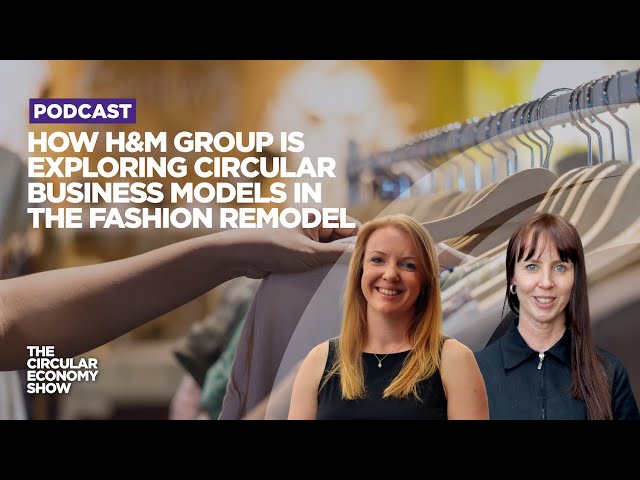
This episode of The Circular Economy Show explores the Ellen MacArthur Foundation’s Fashion ReModel project. Featuring Chloe Holland (Foundation's fashion team) and Sara Eriksson (H&M Group), they discuss scaling circular business models like resale, rental, repair, and remaking to keep clothes in use at their highest value and profitably without new production.
Topics include the Fashion ReModel's ambitions, strategic advantages of circular models, H&M Group's Sellpy platform, and challenges of implementing circular principles in a linear economy. Policy and finance's role in commercial viability is also highlighted. The Ellen MacArthur Foundation, an international charity, promotes a circular economy: eliminating waste, circulating products, and regenerating nature. Learn more at ellenmacarthurfoundation.org and subscribe to their YouTube channel.

This episode of "The Brain Health Revolution" features John Robbins, son of the Baskin-Robbins founder. He famously chose to forgo immense wealth, instead pursuing a "deeper American Dream" focused on a society at peace with its conscience, living in harmony with all life, and practicing compassionate ecosystem stewardship.
A powerful advocate for a sane, ethical, and sustainable future, Robbins has spoken at major conferences, received prestigious honors like the Rachel Carson Award, and appeared on national shows. He co-founded and presides over the Food Revolution Network, which empowers over 600,000 members to transform food systems for healthy people and a healthy planet.
Environmental Scientist and Advocate
What EarthSayers stands for
Discover Diverse Voices on EarthSayers
Unlike algorithm-driven platforms that push you into a content bubble, we ensure you hear a variety of perspectives from scientists, activists, Indigenous leaders, business innovators, and everyday citizens working toward sustainability.
EarthSayers CINEMA
Watch, learn and lead—sustainability starts with you.
The Thinking Game | Full documentary | Tribeca Film Festival official selection
The inside story of the AI breakthrough that won a Nobel Prize.
The Thinking Game takes you on a journey into the heart of leading AI lab DeepMind, capturing a team striving to unravel the mysteries of intelligence and life itself.
Filmed over five years by the award-winning team behind AlphaGo, the documentary examines how DeepMind co-founder Demis Hassabis’s extraordinary beginnings shaped his lifelong pursuit of artificial general intelligence. It chronicles the rigorous process of scientific discovery, documenting how the team moved from mastering complex strategy games to solving the 50-year-old "protein folding problem" with AlphaFold - a breakthrough that would win a Nobel Prize.
Following its world premiere at the Tribeca Festival and a successful international tour, the film is now available here to watch for free.
Interested in hosting a screening of The Thinking Game for your classroom, community, or workplace? Visit: https://rocofilms.com/films/the-thinking-game/
Director Greg Kohs
Producer Gary Krieg
Executive Producers Tom Dore, Jonathan Fildes
Co-Producer Greg Kohs
Editor Steve Sander
Cinematographer Greg Kohs
Composer Dan Deacon


